 Coinmarketcap
 tracks cryptocurrency markets and routes wallet-based swaps without holding user funds
Updated -
Coinmarketcap tracks cryptocurrency prices and market rankings while DEX Mode supports swaps from a self-custody wallet. Its data pages combine exchange information into reference prices and calculated valuations. Trading runs through third-party decentralized exchanges, or DEXs, with direct swaps supported on Solana and BNB Smart Chain. Portfolio and watchlist tools help track assets without creating a platform-held account balance. Charts, educational material and APIs support research beyond a single token's price. A displayed valuation doesn't authenticate a holding or a completed trade. Network charges, protocol fees and on-chain execution risks still apply when the trading interface takes no service fee.
Exchange quotes, prices and rankings
An asset's reference price combines market-pair quotes through volume weighting, so markets with more reported volume have greater influence. A market pair expresses one asset's price in another asset or currency. Exchanges supply the original quote, and the platform converts it to USD using reference prices. The asset-level average combines eligible pair prices after exclusions. This allows a coin page to summarize multiple markets. An individual exchange can still display a different quote because its market is only one input.
Market capitalization equals reference price multiplied by circulating supply. A supply revision can therefore change the valuation even when the price stays unchanged.
Cryptoassets need verified market capitalization for a numbered rank, and top-tier eligibility adds market-quality requirements. Exchange rankings consider liquidity, traffic, reported-volume legitimacy and qualitative factors.
| Metric | Calculation and limitation |
|---|---|
| Cryptoasset price | Volume-weighted average of eligible market-pair prices; excluded prices don't contribute. |
| Market capitalization | Reference price multiplied by circulating supply; the supply classification affects the valuation. |
| Cryptoasset trading volume | Eligible reported spot volume over 24 hours; fee-free or heavily incentivized pairs can be excluded. |
| Reported exchange volume | All reported spot-pair volume over 24 hours; pairs excluded from cryptoasset volume can remain included. |
| Market-pair liquidity | The Market Data methodology describes weighted order-book depth averaged over 24 hours; the separate Liquidity Score methodology estimates slippage from simulated trades. |
Market context and research tools
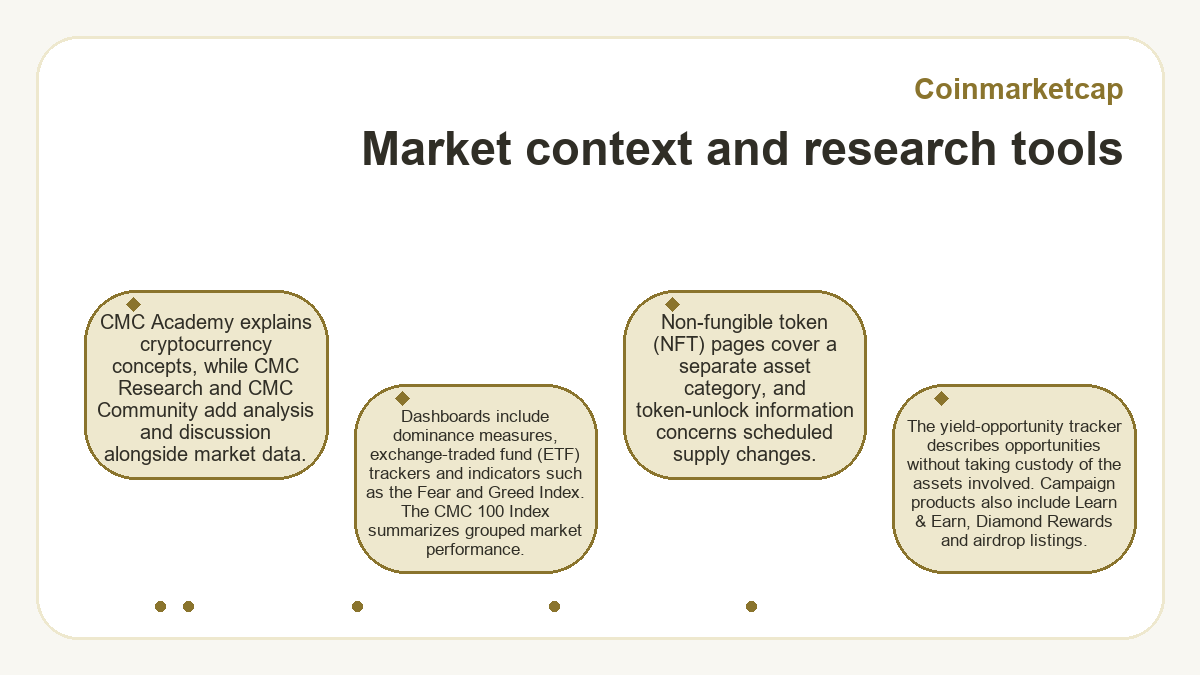
CMC Academy explains cryptocurrency concepts, while CMC Research and CMC Community add analysis and discussion alongside market data. Dashboards include dominance measures, exchange-traded fund (ETF) trackers and indicators such as the Fear and Greed Index. The CMC 100 Index summarizes grouped market performance. Non-fungible token (NFT) pages cover a separate asset category, and token-unlock information concerns scheduled supply changes. The yield-opportunity tracker describes opportunities without taking custody of the assets involved. Campaign products also include Learn & Earn, Diamond Rewards and airdrop listings.
How does DEX Mode connect a wallet to token swaps?
DEX Mode routes token swaps through third-party decentralized exchanges using a compatible self-custody wallet on supported networks. Direct trading covers Solana and BNB Smart Chain (BSC). The interface uses smart routing to connect the trade with DEX liquidity. Coinmarketcap supplies the market view and trading interface, while exchange smart contracts execute the swap. The wallet supplies transaction authorization; the user decides whether to sign. A market quote describes pricing information, not confirmation that a trade has completed.
Coinmarketcap - Market Data Without Custody
- How does DEX Mode connect a wallet to token swaps?
- API access and mobile interfaces
- What does a portfolio balance actually represent?
- Volume filters and liquidity limits
Coinmarketcap charges zero service fees for these DEX Mode swaps. Network transaction charges and the fee that the automated market maker (AMM) protocol charges still apply. Some token contracts also impose buy or sell taxes. Those costs belong to the chain, trading protocol or token contract. Execution also requires the selected chain's native gas asset.
DEX Mode doesn't create a Coinmarketcap account balance that holds the user's crypto.
DexScan's on-chain market coverage extends beyond the networks available for direct trading in this mode. Data coverage and integrated execution have separate scopes. A Trade button for a token outside direct support can lead to a third-party DEX with its own interface and conditions. The integrated interface can also restrict trading in tokens flagged as high risk. A token's presence in a data view doesn't establish that a direct swap is available.
On-chain execution exposes a swap to price movement, slippage, failed transactions and smart contract problems. Slippage describes a difference between expected pricing and execution pricing. Self-custody leaves authorization with the wallet owner; it doesn't remove the trading protocol's risks. Signing a transaction concerns the specific swap and contract interaction, separate from merely following a coin's market page.
API access and mobile interfaces
The website, iOS app and Android app provide ways to view market information. An application programming interface (API) delivers structured data to software. Its product families include cryptocurrency quotes, exchange data, global metrics and DEX data. Keyless access supports evaluation without an account, while registered plans govern broader access and quotas. Dataset coverage and historical depth depend on the endpoint and plan.
What does a portfolio balance actually represent?
A portfolio balance represents tracked holdings valued with market data, rather than crypto held in a Coinmarketcap account. Portfolio records can contain manually entered holdings and purchase prices, or information synchronized from supported wallets and exchanges. The watchlist follows selected assets without serving as a record of executed trades. They don't provide the same evidence as an exchange trade record or a transaction recorded on a blockchain. An amount on screen therefore needs its underlying records to establish what it represents.
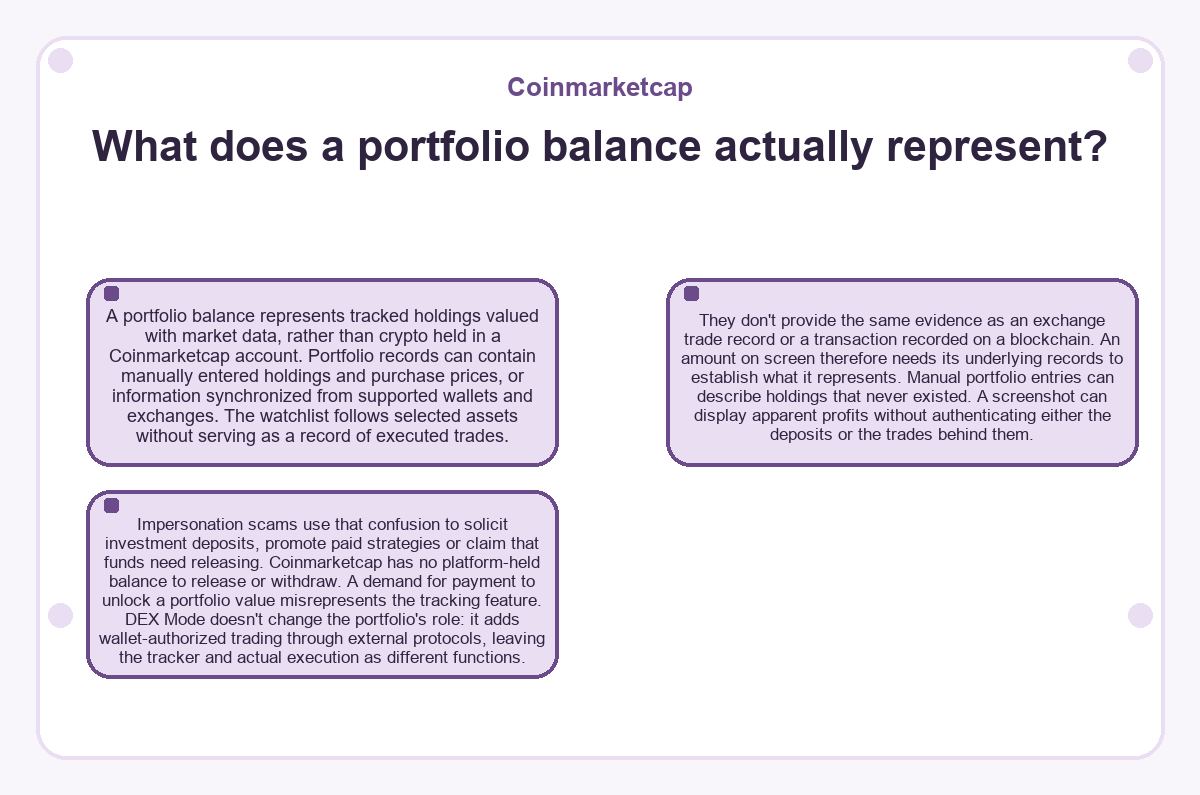
Manual portfolio entries can describe holdings that never existed.
A screenshot can display apparent profits without authenticating either the deposits or the trades behind them. Impersonation scams use that confusion to solicit investment deposits, promote paid strategies or claim that funds need releasing. Coinmarketcap has no platform-held balance to release or withdraw. A demand for payment to unlock a portfolio value misrepresents the tracking feature. DEX Mode doesn't change the portfolio's role: it adds wallet-authorized trading through external protocols, leaving the tracker and actual execution as different functions.
Volume filters and liquidity limits
The 24-hour volume for a cryptoasset aggregates reported spot trading activity after exclusions for certain fee-free or heavily incentivized pairs. Such markets can encourage wash trading, which inflates activity without representing equivalent genuine demand. Exchange reported volume applies a broader inclusion rule, so a market excluded from the coin's volume can remain inside the exchange's total. The aggregate 24-hour trading-volume figure can count a crypto-to-crypto pair on both asset sides.
Market-pair liquidity concerns how easily an asset can be bought or sold. The mid-price is halfway between the best bid and ask. The Market Data methodology describes weighting order size, price proximity and relative depth, then averaging random samples over 24 hours. The separate Liquidity Score methodology estimates slippage by simulating buy and sell orders of different sizes. A higher score indicates stronger liquidity under the measured conditions. Price exclusions also matter: withdrawal restrictions, deposit restrictions, geographic trading barriers or significant price outliers can remove a market from the reference average.
Comparing activity figures requires matching their asset, exchange or aggregate scope before treating a difference as a discrepancy.
Still have questions?
Why do converted prices move when the exchange quote is unchanged?
Converted prices can move because the quote asset's USD reference price or the fiat exchange rate changes. A market-pair price first converts to USD using the quote asset's reference price. A display in another fiat currency then converts that USD figure using the relevant exchange rate. An unchanged raw quote therefore doesn't require every converted display to stay unchanged.
What do asterisks beside market pairs mean?
Asterisks identify different exclusions from the market-data calculations. One asterisk marks a price excluded because it doesn't represent an unrestricted market price. Two asterisks mark a pair excluded from cryptoasset volume because of fee-free trading or substantial incentives. Three asterisks mark a significant price outlier excluded from the reference average. The marks concern different calculations, so they don't all mean that a market's data receives identical treatment.
Which wallets can connect to DEX Mode?
DEX Mode supports connections through Binance Wallet, MetaMask, Phantom, Trust Wallet and WalletConnect-compatible wallets. Compatibility also needs to match the selected network. Support for a connection method doesn't mean that a wallet can execute every swap on every chain. The wallet controls transaction authorization, and connecting it doesn't create a balance held by Coinmarketcap.
Does a token balance cover every DEX Mode network fee?
A wallet needs enough of the selected network's native asset to pay gas. BNB Smart Chain swaps need BNB for gas, and Solana swaps need SOL. Holding the token being traded doesn't necessarily meet that requirement. The wallet's gas balance remains separate from the displayed portfolio value and the interface's zero service fee.
Where should I report a message that impersonates Coinmarketcap?
The platform's support request form and support chatbot are the help channels for suspected impersonation. Coinmarketcap doesn't respond to user support inquiries through WhatsApp or Discord. A message that uses the name or logo doesn't authenticate its sender, especially when it asks for investment deposits or payment to release a supposed portfolio balance.