 Coinmarketcap
 calculates market cap from price and circulating supply
Updated -
Coinmarketcap calculates a token's market cap by multiplying its reference price by circulating supply. That supply estimates tokens in public hands and generally excludes insider allocations, even when those tokens are unlocked. Total supply, maximum supply and unlocked supply answer different valuation questions. Before comparing token valuations, the supply label and verification status matter because a project-reported figure doesn't automatically qualify for ranking. The same price applied to different supply definitions produces different valuations.
Key takeaway: Unlocking insider tokens doesn't automatically increase ranked market cap because ownership still affects the circulating-supply calculation.
Reference price and public supply
A reference price sets the value per token, while circulating supply sets how many tokens enter the valuation. Their product expresses the circulating tokens' value at that price. The currency comes from the price input, and the count must use the corresponding token unit. Eligible market-pair prices contribute to the reference price through volume weighting. Pairs contributing more volume have more influence, while exclusions remove some unsuitable or outlier prices. Price aggregation and supply classification therefore contribute distinct inputs. A low unit price can accompany a large market cap when the circulating count is large.
Wallet ownership and public circulation
The circulating-supply estimate follows public ownership, so an unlocked insider allocation can remain outside the counted float. Team, foundation and treasury holdings generally fall outside circulation. The ability to transfer a token doesn't, by itself, place it in public hands. Ownership and the allocation's purpose affect the treatment.
Locked allocations generally remain outside circulating supply. Legal restrictions can matter alongside smart-contract locks, so an on-chain transfer test doesn't resolve every supply question.
Private-sale allocations and earmarked ecosystem reserves can also fall outside circulation. Airdrop allocations generally remain excluded unless the project provides evidence of active demand, such as recipients registering for the distribution.
Supply analysis needs information about who controls excluded balances. A project's distribution table and identified wallet addresses help distinguish public holdings from reserves, even when both appear on the same blockchain.
Verification and project-reported figures
Verified and self-reported supply figures have different roles on an asset page. The platform applies its own methodology before publishing a verified count. It can display a project's self-reported figure alongside that count, even if the project's method differs. The project-reported number has no ranking implications.
Verification also considers trading venues, volume and liquidity when assessing whether a notional market cap fits the asset's markets. Insufficient documentation or irregularities can prevent verification. A visible minted total doesn't establish how much belongs in the public float, and a project's assertion doesn't replace the platform's assessment.
Price movements and supply revisions
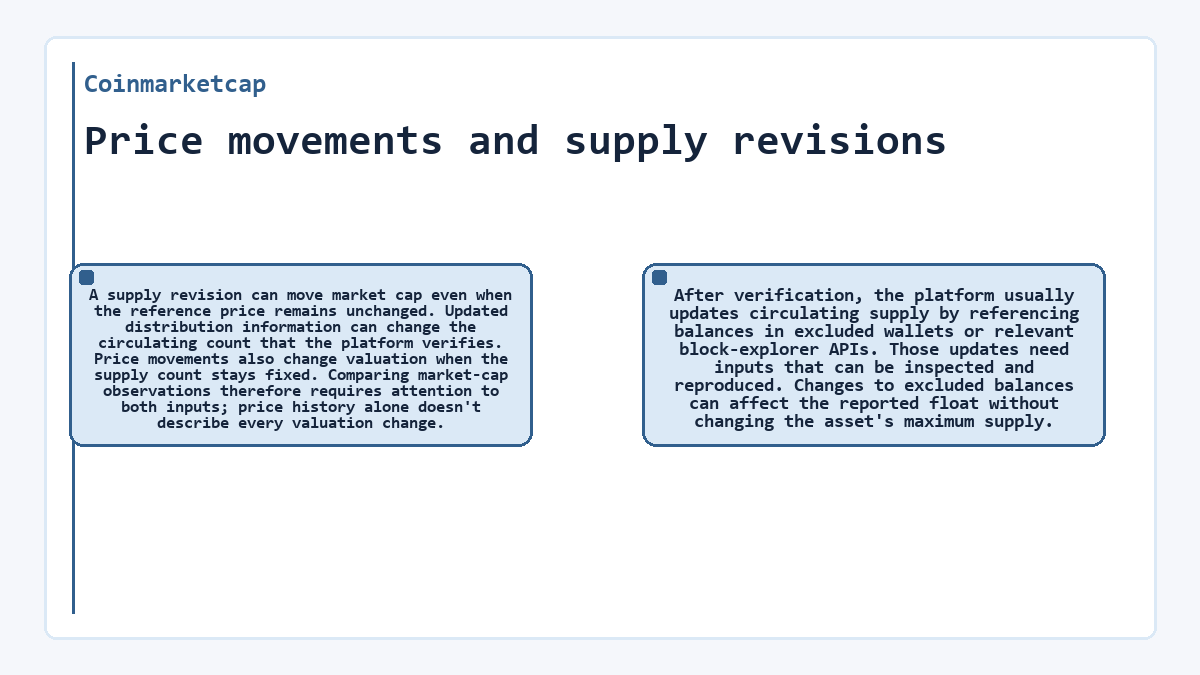
A supply revision can move market cap even when the reference price remains unchanged. Updated distribution information can change the circulating count that the platform verifies. Price movements also change valuation when the supply count stays fixed. Comparing market-cap observations therefore requires attention to both inputs; price history alone doesn't describe every valuation change. After verification, the platform usually updates circulating supply by referencing balances in excluded wallets or relevant block-explorer APIs. Those updates need inputs that can be inspected and reproduced. Changes to excluded balances can affect the reported float without changing the asset's maximum supply.
A fixed price with two supply bases
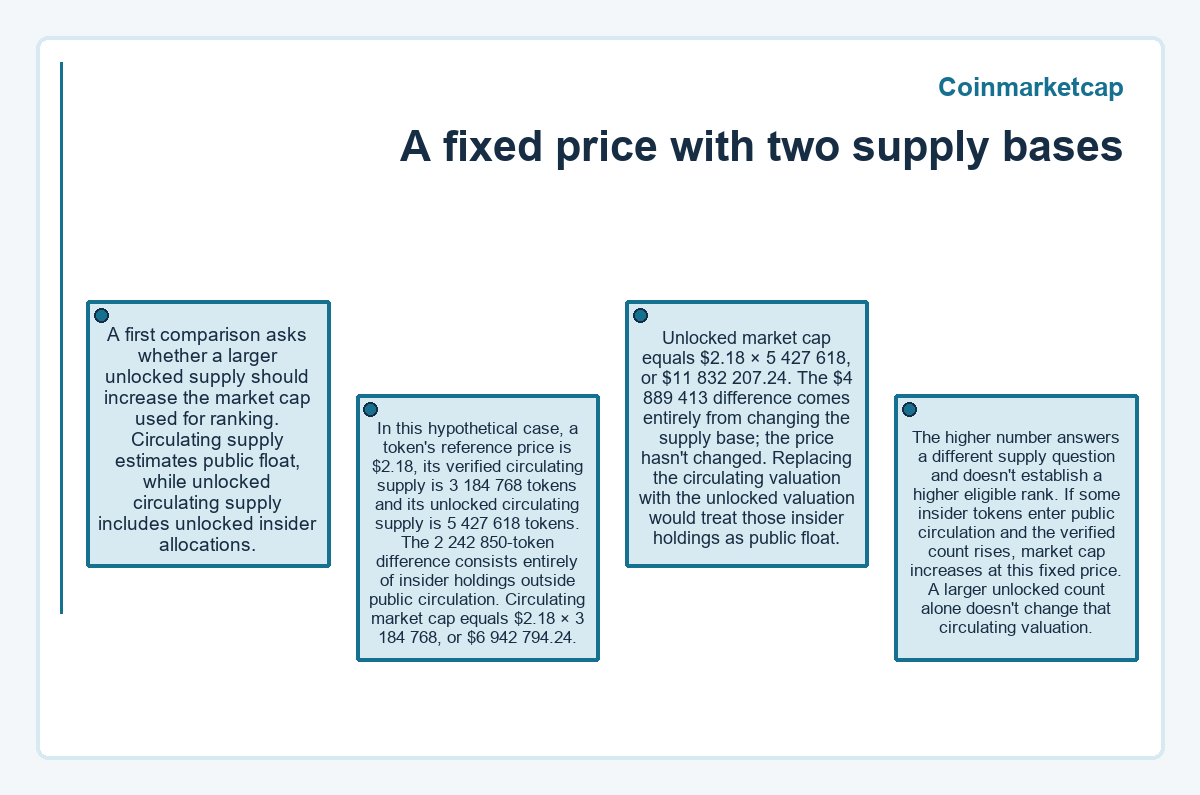
A first comparison asks whether a larger unlocked supply should increase the market cap used for ranking. Circulating supply estimates public float, while unlocked circulating supply includes unlocked insider allocations. In this hypothetical case, a token's reference price is $2.18, its verified circulating supply is 3 184 768 tokens and its unlocked circulating supply is 5 427 618 tokens. The 2 242 850-token difference consists entirely of insider holdings outside public circulation.
Circulating market cap equals $2.18 × 3 184 768, or $6 942 794.24. Unlocked market cap equals $2.18 × 5 427 618, or $11 832 207.24. The $4 889 413 difference comes entirely from changing the supply base; the price hasn't changed.
Replacing the circulating valuation with the unlocked valuation would treat those insider holdings as public float. The higher number answers a different supply question and doesn't establish a higher eligible rank.
If some insider tokens enter public circulation and the verified count rises, market cap increases at this fixed price. A larger unlocked count alone doesn't change that circulating valuation.
Rank eligibility beyond the valuation formula
Top 200 eligibility requires a verified market cap plus compliance with supply verification, evaluation, market-depth, Profile Score and price-consistency criteria. Market depth concerns significant liquidity and tight bid-ask spreads across reliable data sources. The Profile Score must meet a minimum threshold. A large calculated valuation doesn't establish compliance with these additional requirements.
The Top 201+ tier requires verified market capitalization, while the additional Top 200 criteria are optional. The platform leaves assets without verified market capitalization unranked and sorts them by 24-hour trading volume. Rehypothecated assets occupy a separate tier to reduce double-counting of market capitalization.
Supply verification and rank eligibility use a best-efforts assessment because monetary models differ. A valuation formula can't remove uncertainty about an asset's distribution.
Market cap and executable liquidity
Market cap values the counted supply at a reference price; liquidity concerns available buying and selling interest. The valuation doesn't measure cash deposited into the project or the proceeds from selling every circulating token. Execution prices can change as orders consume liquidity. Order-book depth and expected slippage address execution conditions that market cap doesn't contain. A highly ranked asset can still have markets with different trading conditions. Reported volume measures activity over a period, while liquidity describes capacity to accommodate orders. Neither substitutes for the supply definition used in valuation.
Total, maximum and unlocked supply valuations
Total supply counts tokens already in existence after subtracting verified burns. It includes locked and unlocked tokens, so it can exceed circulating supply. Multiplying total supply by price gives minted market capitalization. This valuation includes existing allocations that the public-float calculation excludes.
Maximum supply estimates the lifetime token limit after accounting for verified burns. Multiplying that maximum by price gives fully diluted valuation, or FDV. FDV applies the current reference price to the maximum count; it doesn't establish the price that tokens will reach when additional supply becomes available.
Unlocked circulating supply subtracts unminted and locked tokens from maximum supply net of verified burns. Price multiplied by that unlocked count gives unlocked market capitalization. These definitions keep existing supply, public float and unlocked allocations distinct. When total and maximum supply coincide, minted market cap and FDV can coincide at the same price. Burn accounting needs a consistent basis. Subtracting burns again from a maximum-supply figure that already excludes them would undercount unlocked tokens.
Release schedules and the public-float boundary
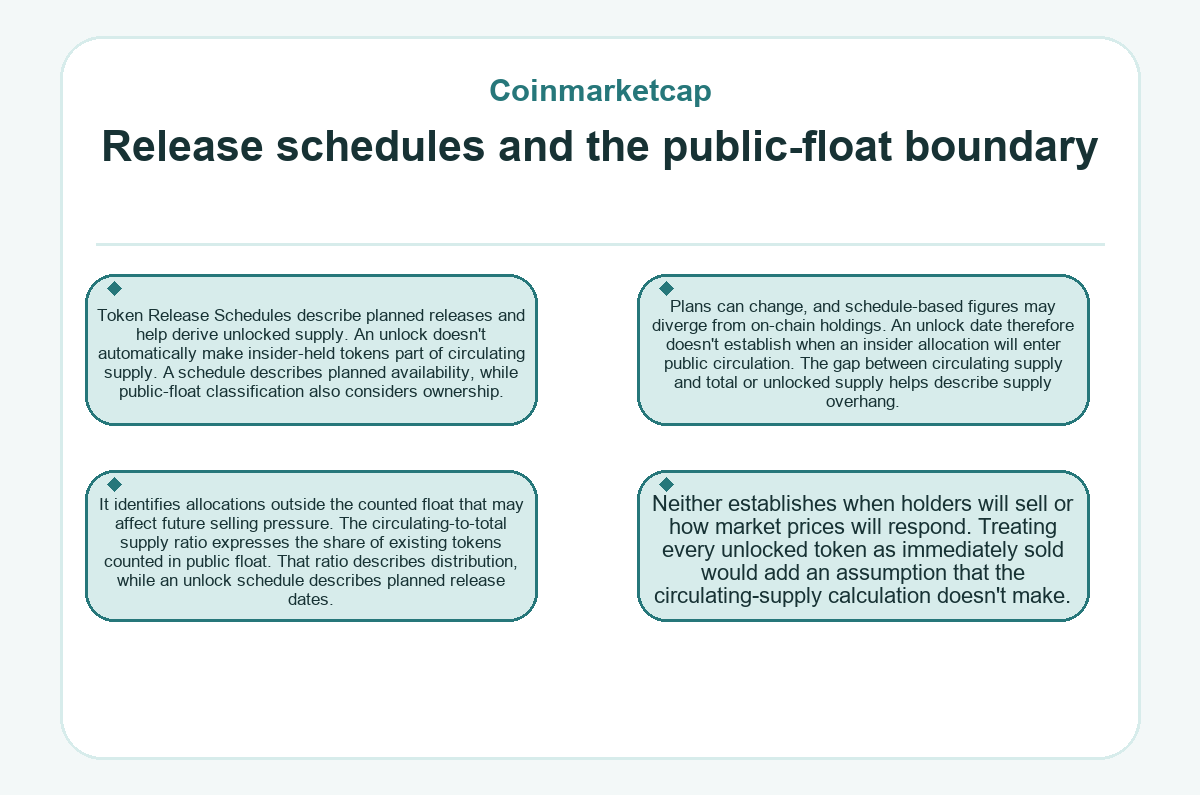
Token Release Schedules describe planned releases and help derive unlocked supply. An unlock doesn't automatically make insider-held tokens part of circulating supply. A schedule describes planned availability, while public-float classification also considers ownership. Plans can change, and schedule-based figures may diverge from on-chain holdings. An unlock date therefore doesn't establish when an insider allocation will enter public circulation.
The gap between circulating supply and total or unlocked supply helps describe supply overhang. It identifies allocations outside the counted float that may affect future selling pressure. The circulating-to-total supply ratio expresses the share of existing tokens counted in public float. That ratio describes distribution, while an unlock schedule describes planned release dates. Neither establishes when holders will sell or how market prices will respond. Treating every unlocked token as immediately sold would add an assumption that the circulating-supply calculation doesn't make.
Comparable valuations need matching inputs
A market-cap comparison needs the same supply definition for each asset and price observations from a comparable period. Circulating market cap compares public float. FDV compares maximum-supply valuations, while unlocked market cap compares unlocked allocations. Mixing those measures can make differences in supply accounting look like differences in market size.
A watchlist helps organize assets for monitoring; it doesn't make different supply definitions equivalent. A first valuation review can stay with the displayed price, supply count and verification status without initiating a trade. Multiply the price by the verified circulating count in matching token units to calculate a circulating valuation. A revision to the supply definition or verification status can make an earlier comparison unsuitable, even when prices appear unchanged.
Practical questions about Coinmarketcap
What does a blank circulating-supply figure mean for a market-cap calculation?
A blank circulating-supply field leaves the circulating market-cap calculation without a required input. It doesn't establish that supply or market cap equals zero. A total-supply or maximum-supply figure answers a different valuation question, so substituting either count changes the calculation's meaning. Keep that distinction even when a price is available.
Which records does a project submit to update verified supply?
A supply submission needs distribution details that let the platform assess the public float. Relevant records include initial distribution, private allocations, locked addresses, team-controlled addresses and balances reserved for future use. The platform examines blockchain data and the distribution table. A published supply number alone doesn't replace those supporting records.
Does trading on three supported exchanges guarantee a verified supply figure on Coinmarketcap?
Trading on three supported exchanges doesn't guarantee supply verification. The general guideline calls for material trading activity on at least three supported exchanges with tracked-listing status. The project must also provide documentation that satisfies the supply methodology. Liquidity, volume and trading venues enter the assessment, so meeting the exchange-count guideline alone doesn't establish approval.
Are tokens staked in masternodes always excluded from circulating supply?
Masternode staking doesn't have a universal exclusion rule under the supply methodology. The platform assesses those holdings case by case, considering distribution, ownership and lock-up periods. Calling tokens staked or unlocked doesn't settle whether they belong in the public circulating count.
When should a project submit a token-swap request instead of a supply update?
A coin or token swap, including a redenomination, uses the dedicated swap-request category. The verified-supply update category addresses changes to supply figures for an existing asset. These request types describe different changes, so a swap shouldn't be presented merely as an updated circulating count. The applicable submission instructions determine the required information.
Why can aggregate market cap differ from adding every displayed asset valuation?
Coinmarketcap's aggregate market cap sums asset market capitalizations that meet its inclusion requirements. It doesn't automatically include every displayed valuation. Summing self-reported figures, FDVs or separately treated rehypothecated assets can produce a different total. A matching comparison needs the same eligibility rules and valuation basis as the aggregate.
How does redenomination affect a comparison with earlier market-cap figures?
Redenomination changes the token unit, so the price and supply count must use matching denominations. Multiplying an old-unit price by a new-unit supply count mixes incompatible inputs. Market caps calculated with matching old-unit inputs and matching new-unit inputs remain comparable in the same currency. A numerical difference created by mismatched units doesn't establish a change in circulating value.
Should market caps displayed in different fiat currencies be compared directly?
Market caps need a common fiat-currency basis for direct comparison. The valuation inherits the currency of its price input, and non-USD fiat display prices use conversion from USD with foreign-exchange rates. Converting both valuations to the same currency removes that unit mismatch. Exchange-rate movements can still change the displayed values independently of token supply.